The Citizens' Assembly: From Government Baseline to People's Reality
It starts with the real 119th Congress. Then, seat by seat, the people take over.
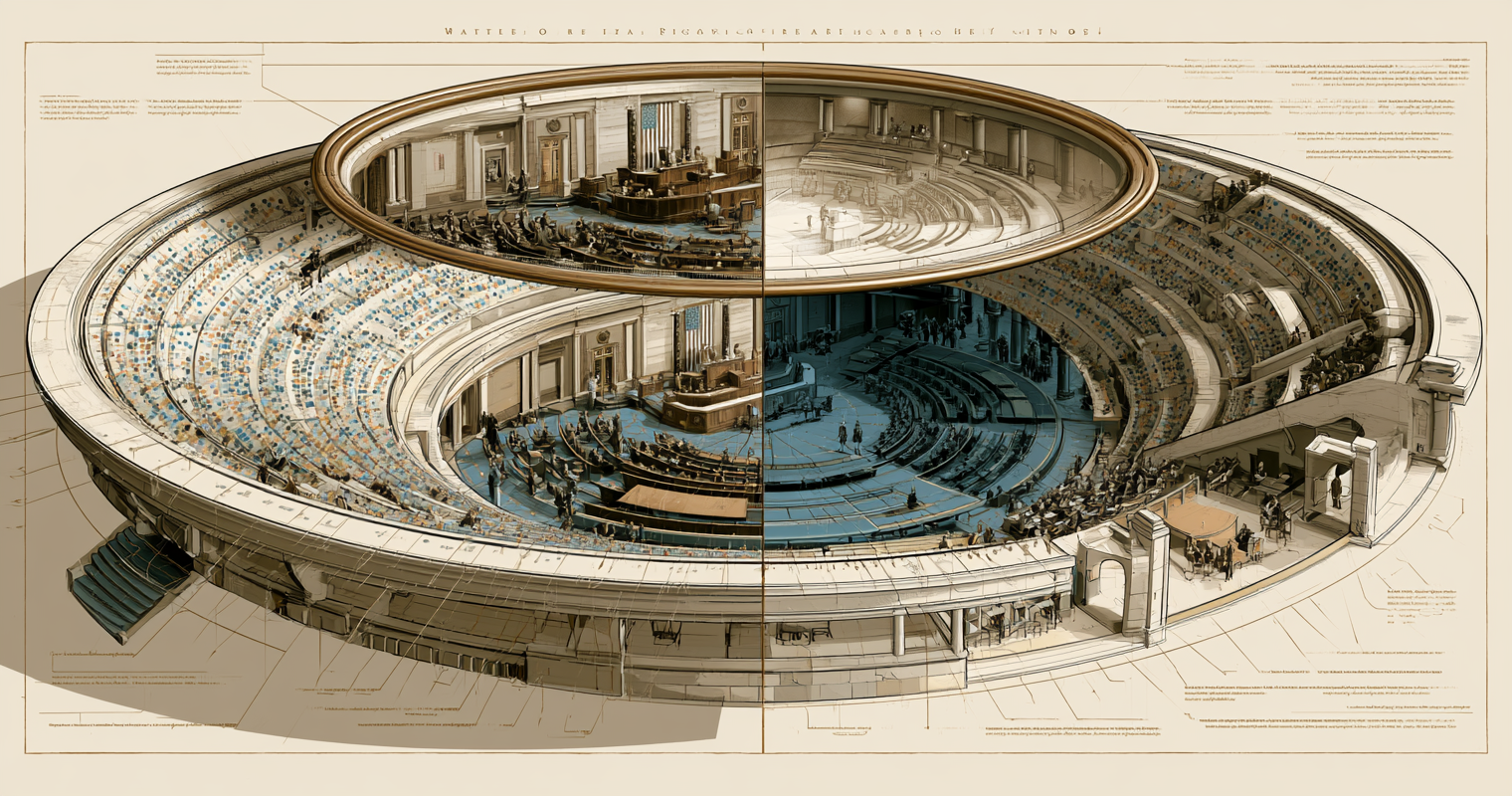
Starting with Reality
When you first load Constitution.Vote, the parliament visualization shows you something familiar: the actual U.S. Congress. House seats are allocated exactly as they stand after the 2024 elections — Republican 220, Democratic 215. The Senate shows its real composition: Republican 53, Democratic 45, Independent 2.
This isn't decoration. It's a baseline — the starting point against which everything that follows will be measured. These numbers come from official government sources: the House Press Gallery party breakdown and the Senate's own party division records. They represent the congress America has.
But the whole point of Constitution.Vote is to answer a different question: what congress would America choose?
The Transition: Government Reality → People's Reality
As real users join the platform, take the political alignment quiz, and join parties, a second dataset begins to grow alongside the government baseline. Every new member shifts the balance. At first, the effect is invisible — a handful of users can't meaningfully challenge a dataset representing 535 congressional seats.
But there's a threshold. Once the platform reaches a critical mass of verified users — currently set at 1,000 party-affiliated members — the seat allocation algorithm begins to blend the two realities. The government baseline fades. The people's data rises. The transition is gradual, proportional, and transparent.
Past the threshold, seats are allocated purely by platform membership proportions. If 12% of verified users belong to the Libertarian Party, the Libertarians hold 12% of the seats in the Citizens' Assembly. No gerrymandering. No winner-take-all districts. Pure proportional representation based on what people actually believe.
Watching the Seats Flip
This is where it gets electric. As the platform grows, users will literally watch seats change color in the parliament visualization. A seat that was Republican red might flip to Libertarian gold. A cluster of Democratic blue might give way to Green or Working Families purple. New parties that don't exist in the real Congress — parties born on the platform itself — will start claiming seats from the established order.
Every flip tells a story. It says: "Here's what America's representation looks like when the people actually choose." The gap between the government parliament and the people's parliament becomes the most powerful visual argument for democratic reform imaginable.
And it works at every scale. The county map undergoes the same transition — starting with 2024 election results and gradually reflecting platform voting as users in each county make their voices heard. A red county might stay red, or it might reveal surprising pockets of libertarian, green, or independent sentiment that the two-party system never surfaces.
Why the Baseline Matters
Starting with real congressional data isn't just a design choice — it's a statement of intellectual honesty. The platform doesn't pretend to exist in a vacuum. It acknowledges the current reality and then asks: would you build the same congress if you could start fresh?
The baseline also provides credibility. When a journalist or politician looks at the Citizens' Assembly and sees that it started with verified government data, they know the platform isn't manufacturing a narrative. The departure from the baseline is earned — every seat flip represents real people making real choices.
Over time, the baseline becomes a historical artifact: "This is what America's congress looked like before the people spoke." The further the platform's parliament diverges from the government's, the stronger the signal that representation needs reform. And if it doesn't diverge much? That's meaningful too — it would suggest that, despite all frustrations, the current system isn't as misaligned as critics fear.
Ready to make your voice heard?
Join the people's assembly and vote on the issues that matter. Your voice, verified and counted.
Continue Reading
How Constitution.Vote Works
The complete guide to the people's assembly — from your first vote to shaping national consensus.
Modern ContextThe Case for a People's Assembly
What if the people had their own congress — not to pass laws, but to make their will undeniable?
Modern ContextThe American Hive Mind
What happens when 330 million individual opinions crystallize into a collective intelligence?