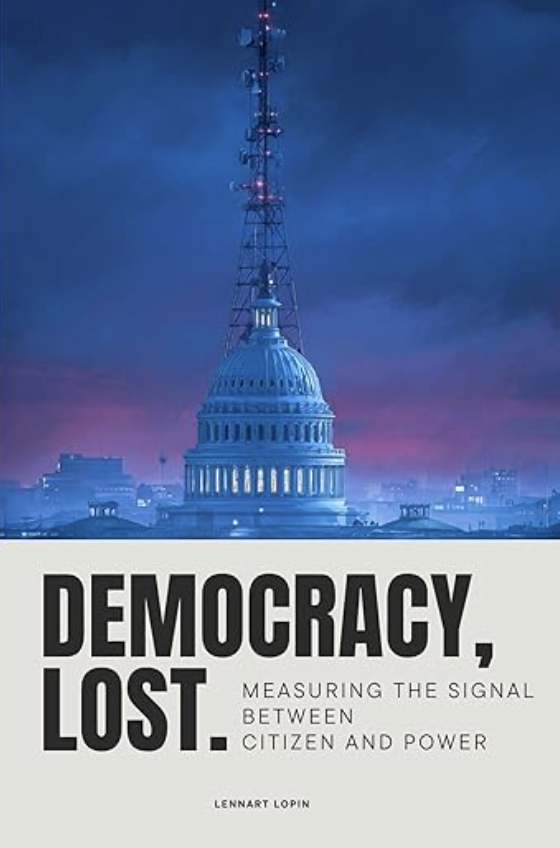
Review: Democracy, Lost — Measuring the Signal Between Citizens and Power
Lennart Lopin applies Claude Shannon's information theory to American democracy and finds the channel is transmitting at 2.7% capacity. The math is open. The conclusion is devastating.
The Number That Changes Everything
Some books argue. This one measures. Democracy, Lost by Lennart Lopin begins with a deceptively simple question: if democracy is a communication channel — a mechanism for transmitting the policy preferences of 330 million citizens to the legislative machinery of government — what is its capacity? And how much of that capacity is actually being used?
The answer, computed using Claude Shannon's information theory on Martin Gilens's dataset of 1,836 policy questions spanning decades, is 0.025 bits out of a theoretical maximum of 0.934 bits. That's a channel operating at 2.7% of capacity. The remaining 97.3% is noise — preferences expressed by citizens that produce no corresponding legislative output.
This isn't a metaphor. It's a physical measurement, derived from the same mathematical framework that governs every fiber-optic cable, wireless signal, and data stream on Earth. Lopin, who spent years as a computational linguist before turning his tools on political systems, makes the case that democracy's failure is not ideological but informational. The channel is broken. The math proves it.
Shannon Meets Madison
The book opens not in a library but on a flight from Dubai to Saskatoon, Saskatchewan — where Lopin, tracing the flow of potash wealth from Canadian soil through layers of corporate extraction to the server racks of a "distant, insulated elite," arrives at the question that would consume years of work: what is the exact syntactic failure mode of democratic machinery?
His insight is to treat democracy as an engineering problem rather than a philosophical one. Shannon's 1948 paper, A Mathematical Theory of Communication, showed that any channel — a telephone wire, a neural pathway, a democratic system — has a measurable capacity. You calculate it by comparing inputs (what citizens want) to outputs (what government does) and computing the mutual information between them.
The Gilens dataset provides the perfect corpus: 1,836 policy questions where public preferences, stratified by income, are paired with the actual legislative outcomes. It's the democratic input-output matrix, ready-made for Shannon's equations. The fact that nobody had combined these two frameworks in 78 years of coexistence is, as Lopin notes, "one of the most baffling blind spots in the history of modern quantitative analysis."
The Structure: Measurement, Comparison, Diagnosis, Prescription
The book is organized into four parts, each building on the last. Part I: The Measurement establishes the 2.7% figure and then systematically dismantles the standard objections. "It's a republic, not a democracy" — addressed. "But we must protect minorities" — addressed. "Pure democracy is mob rule" — addressed. Each chapter takes a common defense of the status quo and runs it through the information-theoretic framework.
Part II: The Comparison asks whether other democratic systems perform better. Switzerland — with its frequent referendums, citizen initiatives, and direct popular participation — serves as the primary comparison case. The chapter "Is a Better Channel Technologically Possible?" anticipates Constitution.Vote itself, exploring how digital infrastructure could increase channel capacity.
Part III: The Diagnosis goes deeper, examining the "biology of capture" — how institutional structures naturally evolve to minimize signal transmission — and "The Missing 96%," which traces exactly where the democratic signal degrades as it passes through the representational apparatus.
Part IV: The Prescription asks what a high-capacity democratic channel would look like, introduces the concept of "the signal that generates itself" (self-reinforcing feedback loops of civic participation), and closes with blueprints — concrete, implementable designs for systems that could raise the channel from 2.7% toward its theoretical maximum.
Why This Book Matters Now
What makes Democracy, Lost unusual — and unusually important — is its refusal to take sides. The 2.7% figure is not a progressive complaint or a conservative grievance. It's a measurement. The math doesn't care about national myths. It doesn't care about the performative theater of elections. It cares about one thing: how much of the input signal reaches the output.
The book is also refreshingly transparent. The code is open-source, available on GitHub. The data sources are public (Gilens's replication dataset, Stimson Policy Mood, DW-NOMINATE, Voteview). The computational tools are listed (Python 3.14, pandas, scipy, scikit-learn). Any reader can reproduce the calculation. Few books about democracy invite you to check the arithmetic.
Disclosure: Lennart Lopin is the founder of Constitution.Vote. The book's thesis — that the democratic channel operates far below capacity and that technology can help close the gap — is the intellectual foundation of this platform. We believe the argument stands on its math, but readers should know the connection.
Book Details
Title: Democracy, Lost: Measuring the Signal Between Citizens and Power
Author: Lennart Lopin
Publisher: Euler's Identity Press, Sarasota, Florida
Year: 2026 (First Edition)
ISBN: 979-8-2556-1942-9
Pages: 400+ (includes technical appendix, endnotes, bibliography, and index)
Availability: Amazon
Ready to make your voice heard?
Join the people's assembly and vote on the issues that matter. Your voice, verified and counted.
Continue Reading
Why Your Voice Is Missing from Washington
The representation gap is real, measurable, and getting worse. Here's what the data says.
Civic FoundationsRepresentative vs. Direct Democracy
Two visions of self-governance — and why the best system might be both.
Modern ContextThe American Hive Mind
What happens when 330 million individual opinions crystallize into a collective intelligence?